A transmission jack does one job a floor jack does badly: it supports a heavy, awkwardly shaped gearbox, lets you tilt it to follow the engine’s angle, and lowers it under control. There are two main types, plus adapters that turn a floor jack into a light-duty transmission jack. Which one is right depends first on how the vehicle is raised.
The three options at a glance
| Type | Vehicle raised on | Pump | Our capacity range | Best for |
|---|---|---|---|---|
| Telescopic (high-lift) | Two- or four-post lift | Foot pump | 0.5–1.5 t | Garages and dealers with lifts |
| Low-profile (floor type) | Jack stands or a pit | Hand pump | 0.5–1 t | Home garages, mobile mechanics, pits |
| Floor-jack adapter | Jack stands | The floor jack’s pump | Light gearboxes | Occasional clutch and gearbox jobs |
Telescopic (high-lift) transmission jacks
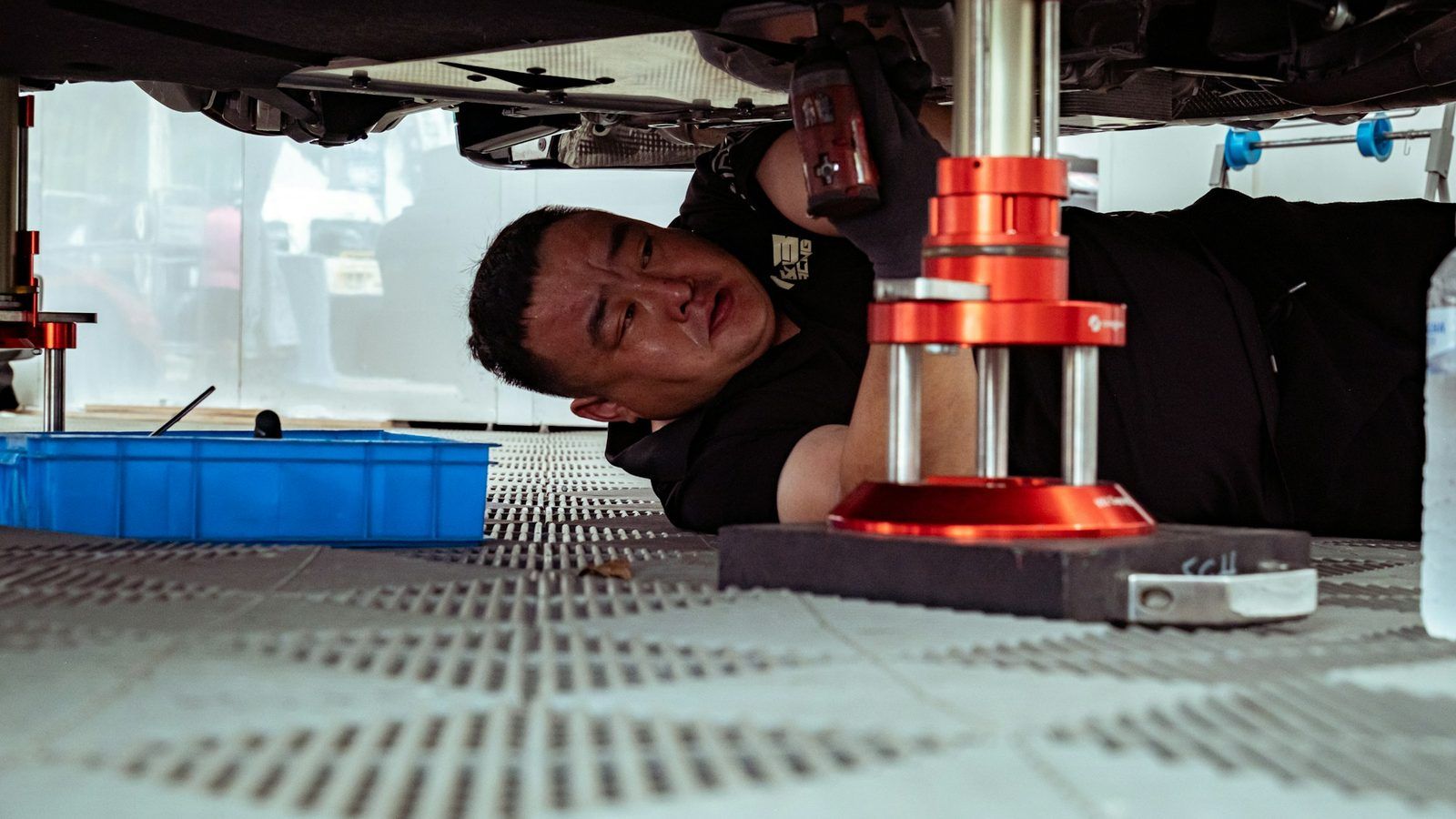
A telescopic jack stands upright on a wide base with four casters. A two-stage ram gives the height to reach a gearbox on a vehicle raised on a lift, and a foot pump keeps both hands on the transmission. The saddle tilts in two directions with screw adjusters. This is the standard type in workshops with two-post or four-post lifts. See our telescopic transmission jacks.
Low-profile (floor) transmission jacks
A low-profile jack looks like a long floor jack with a wide, tilting saddle. It rolls under a vehicle on stands or over a pit, the long chassis reaches the gearbox from the side, and a hand pump raises the saddle. It is the right type when there is no lift. See our low-profile transmission jacks.
Transmission jack adapters for floor jacks
An adapter replaces the saddle of a floor jack with a wider cradle, sometimes with tilt adjustment and a strap. It is a low-cost option for an occasional clutch job on a light gearbox. Its limits are the floor jack’s narrow saddle post, small tilt range and the arc the saddle travels as it rises; for regular work, or for automatic transmissions, a dedicated transmission jack is safer.
How to choose a transmission jack
- Lift or stands: telescopic for a vehicle on a lift, low-profile for a vehicle on stands or over a pit.
- Capacity by gearbox weight: 0.5 t covers passenger-car manual gearboxes; 1 t most automatic transmissions and transfer cases; 1.5 t light-truck and van units. Weigh the unit with its torque converter or transfer case attached.
- Height range: the minimum saddle height must fit under the gearbox; the maximum must reach it. Both are in each model table.
- Saddle tilt: fore-and-aft and side-to-side adjustment with screw adjusters, so the input shaft can be lined up without levering.
- Strap or chain: a safety strap or chain that holds the gearbox on the saddle. Ours ship with every jack.
- Base and casters: a wide base and swivel casters that roll smoothly on your floor while loaded.
- Pump and release: a foot pump on telescopic jacks; a controlled release valve on both.
How to use a transmission jack safely
- Support the vehicle securely on a lift, or on jack stands on level concrete, never on a jack.
- Drain the fluid if required and disconnect the shafts, lines, wiring and cross-member as the service manual says.
- Position the jack under the transmission and raise the saddle until it just takes the weight.
- Strap the transmission to the saddle and adjust the tilt to match its angle.
- Remove the bell-housing bolts and slide the transmission straight back, off the dowels and the input shaft, adjusting the tilt as you go.
- Lower it slowly, keep it strapped, and move the jack with the load as low as possible.
- To refit, reverse the steps: raise and tilt until the input shaft lines up, then slide the unit forward without forcing it.
For distributors
Transmission jacks sell alongside engine cranes, stands and floor jacks, and usually share a container with them. Adapter kits and straps are the accessories customers ask for; bundle them. We build telescopic and low-profile jacks from 0.5 to 1.5 tons with tilting saddles, CE marked, in your colour and with your label, from 10 pieces per model.
See our transmission jacks or request a quote.