Buyers who ask “bottle jack or floor jack?” usually need both. They do the same basic job, but their shape decides how low they start, how high they reach, how stable they are and where they can be carried. Below is a side-by-side comparison with real figures from our catalogue, which vehicle suits which jack, and how distributors split the two in a first order.
What is a bottle jack?
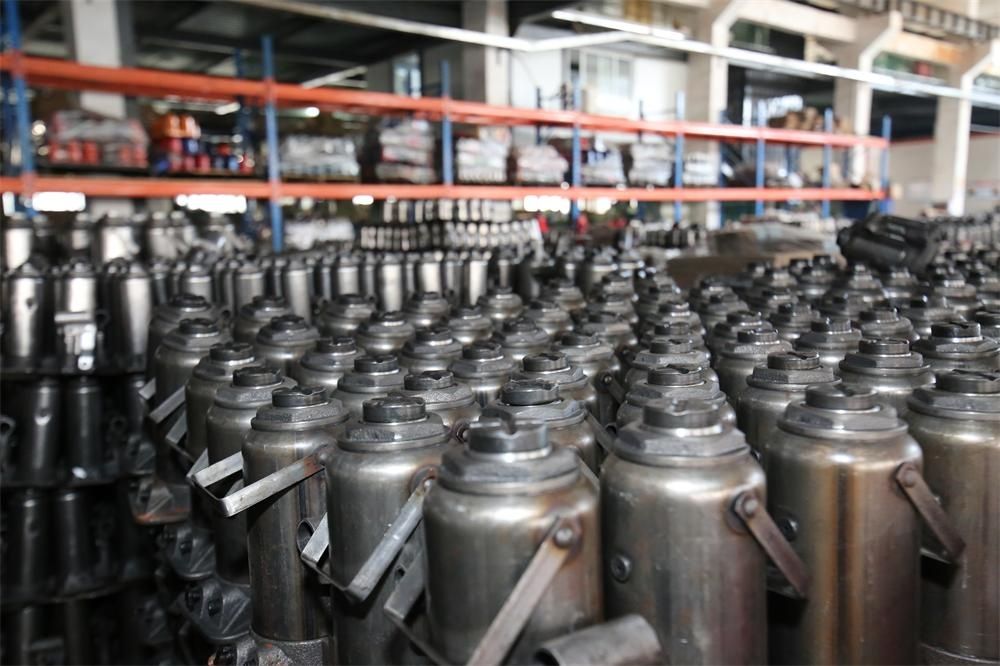
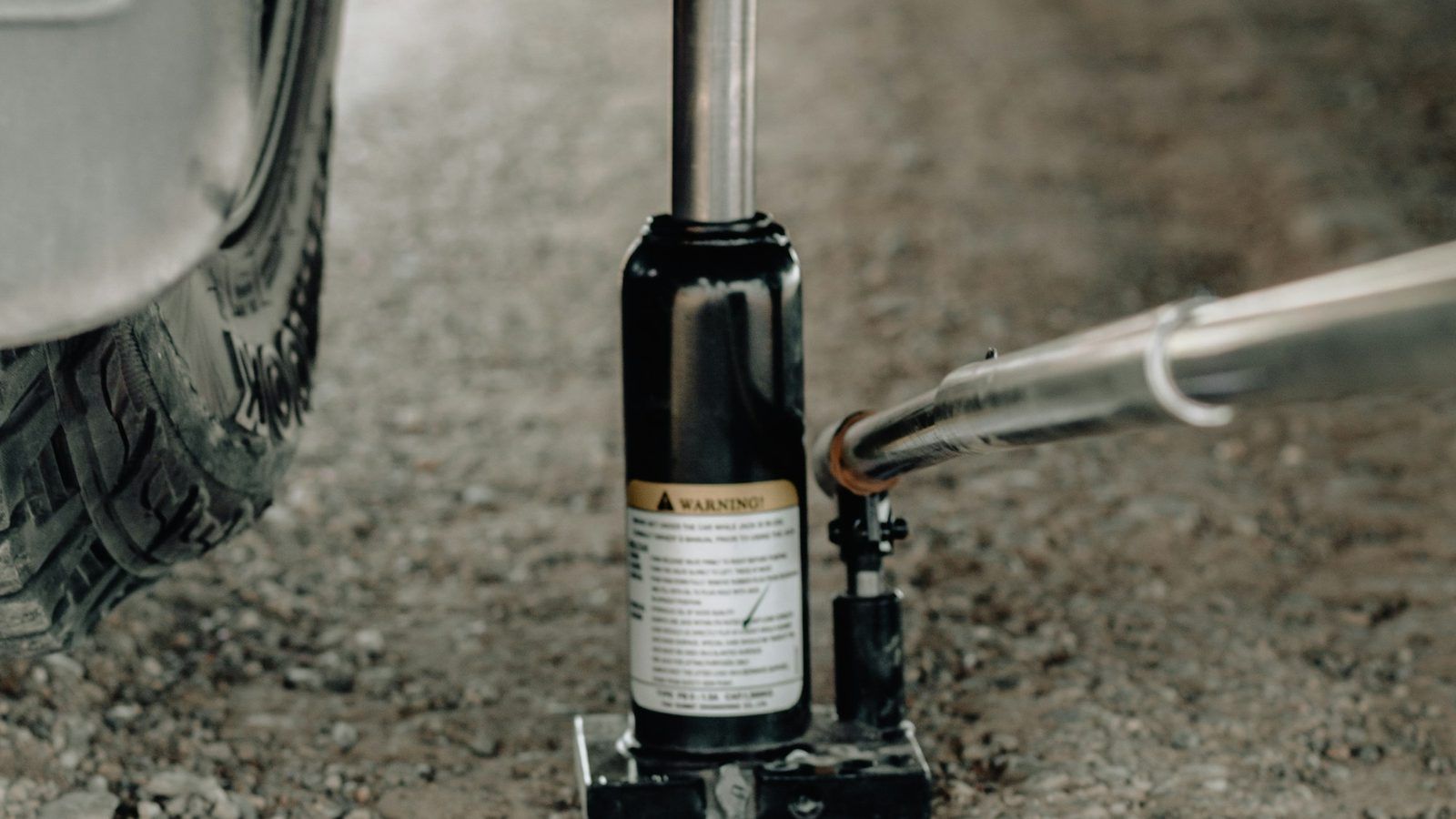
A bottle jack is a compact vertical hydraulic jack: a cylinder inside a bottle-shaped oil reservoir, with a pump and handle on the side. The ram rises straight up, usually topped by a screw extension that closes the gap to the lift point. Capacities run from 2 tons for cars to 50 tons for trucks and machinery, and up to 200 tons for industrial work. Bottle jacks are cheap to ship, fit in a trunk or toolbox, and are very strong for their size.
What is a floor jack?
A floor jack, or trolley jack, is a low chassis on wheels with a long lift arm. The hydraulic unit lies flat and pushes the arm, so the saddle rises in an arc through a wide height range. It rolls under the vehicle, lifts quickly with a long handle, and is stable on its wide wheelbase. Car and SUV models run from 1.5 to 4 tons; long-chassis versions from 5 to 20 tons serve trucks and buses.
Side-by-side comparison
Figures are from JackMaker catalogue models; other makes are in the same range.
| Bottle jack | Floor jack | |
|---|---|---|
| Shape | Vertical cylinder, small base | Low chassis on four wheels, lift arm |
| Typical capacities | 2–50 t (industrial up to 200 t) | 1.5–4 t for cars; 5–20 t long chassis |
| Height fully lowered | 148 mm (5.8 in) for 2 t; 235 mm (9.3 in) for 20 t | 135 mm (5.3 in) standard; 70–85 mm (2.8–3.3 in) low profile |
| Maximum height | 278 mm (10.9 in) for 2 t; 440 mm (17.3 in) for 20 t, with screw | 495 mm (19.5 in) on a 3 t garage jack |
| Weight | 2.3 kg (5 lb) for 2 t; 10 kg (22 lb) for 20 t | 33.5 kg (74 lb) for a 3 t garage jack; 5.5 kg (12 lb) for a 2 t compact |
| Stability | Small footprint; must be centred on firm ground | Wide wheelbase; rolls into position |
| Lifting speed | Many short strokes | Fewer strokes; dual-pump models faster still |
| Portability | Fits in a trunk or toolbox | Stays in the garage or workshop |
| Price per ton of capacity | Lowest | Higher |
Which one should you use?
Sedans, hatchbacks and lowered cars: floor jack. The side lift points of most cars sit lower than a bottle jack’s starting height. A standard floor jack starts at around 135 mm (5.3 in); low-profile models at 70–85 mm (2.8–3.3 in) for sports cars and lowered vehicles.
SUVs and pickups: either. High ground clearance leaves room for a bottle jack under the axle or frame. A 3-ton floor jack with a maximum height near 500 mm (19.5 in) is quicker and more stable for regular work.
Trucks, vans, tractors and machinery: bottle jack. Above about 10 tons a bottle jack is the practical choice: a 20-ton unit weighs 10 kg (22 lb). For truck workshops, long-chassis floor jacks of 10–20 tons are the stable alternative.
Roadside and vehicle kits: bottle jack. Small, light and strong enough for a wheel change on a van or pickup.
Daily workshop and tyre-shop use: floor jack. It rolls into place, lifts in a few strokes, and the release valve is worked from the handle.
Pros and cons
Bottle jack
- Very high capacity for its size and weight
- Compact to store, carry and ship
- Lowest price per ton of capacity
- Starts too high for many cars
- Short lift travel, small base, slower lifting
Floor jack
- Low starting height and a wide lift range
- Stable, easy to position, quick to lift
- Handle-operated release for controlled lowering
- Heavy and bulky; not for a trunk
- Costs more per ton of capacity
Can you use a bottle jack on a car?
Yes, if the jack fits under a proper lift point and the car is on firm, level ground. Check the clearance at the point first: a standard 2-ton bottle jack needs 148 mm (5.8 in), a 6-ton 185 mm (7.3 in). Rear axles and some subframe points usually have room; side pinch welds often do not. Welded low-height bottle jacks start lower (105 mm, 4.1 in, for our 2-ton welded model) but lift only about 50 mm, which suits spreading and adjustment work more than wheel changes. For low cars, use a floor jack.
One rule for both: lift with the jack, hold with stands
Whichever jack you use, it is a lifting device. Lower the vehicle onto a pair of jack stands before anyone goes underneath. Our guide to using jack stands shows where to put them on cars, SUVs and trucks.
For distributors: how to split the first container
A typical first 40’HQ for a general auto-parts importer:
- Bottle jacks: 2, 4, 6, 10, 12 and 20 tons in one colour series, plus a blow-moulded-case version at 2–4 tons for retail
- Floor jacks: 2- and 3-ton steel garage jacks, plus one 3-ton low-profile model
- Jack stands: 3 and 6 tons, packed in pairs; they sell with every jack
Truck-equipment importers skip the 2-ton floor jack and add air hydraulic jacks and 10–20-ton long-chassis floor jacks. Mixed containers are normal from 10 pieces per model.
Certification and naming by market
German buyers ask for GS-certified bottle jacks; our TÜV Rheinland GS certificate covers bottle jack models, and the covered models are listed on our certifications page. UK buyers search for “trolley jack” and “axle stands”, US buyers for “floor jack” and “bottle jack”. We print the terms your market uses on the label and in the manual.
Compare the ranges: hydraulic bottle jacks 2–200 t and hydraulic floor jacks 1.5–20 t, or request a mixed-container quote.