Every jack in our catalogue, from a 2-ton bottle jack to the cylinder of a 50-ton shop press, works on the same principle. Knowing how it works makes it easier to choose the right jack, to write a clear manual, and to find the cause when a jack will not lift or will not hold.
Pascal’s law in one minute
In a closed container of liquid, pressure is the same everywhere. Push on a small piston and you create pressure; that same pressure acts on every square millimetre of a larger piston connected to it. Because force equals pressure times area:
- pressure in the oil: p = F₁ ÷ A₁ (force on the pump piston divided by its area)
- force on the ram: F₂ = p × A₂ (the same pressure times the area of the ram)
The force is multiplied by the ratio of the two areas, A₂ ÷ A₁. Oil makes this practical: it is almost incompressible, it lubricates the moving parts and it seals well against rubber.
A worked example: how 20 kg of hand force lifts 3 tonnes
The figures below illustrate the principle; they are not the dimensions of a particular model.
| Step | Value |
|---|---|
| Pump piston | Ø 10 mm, area 78.5 mm² |
| Ram | Ø 40 mm, area 1,257 mm² |
| Area ratio | 16:1 |
| Handle leverage | 10:1 |
| Your hand on the handle | 200 N (about 20 kg) |
| Force on the pump piston | 2,000 N |
| Oil pressure | 2,000 ÷ 78.5 ≈ 25.5 N/mm² = 25.5 MPa (255 bar, about 3,700 psi) |
| Force on the ram | 25.5 × 1,257 ≈ 32,000 N, about 3.3 t |
Nothing comes free: what you gain in force you pay for in distance. With a 16:1 area ratio, a 20 mm pump stroke raises the ram 1.25 mm, so 100 mm of lift takes about 80 strokes. That trade-off explains most of the differences between jack designs. Floor jacks use a lift arm and a second pump piston to cover distance quickly; bottle jacks use a screw extension so the ram does not spend strokes closing an empty gap.
The parts inside a hydraulic jack
| Part | What it does | What goes wrong |
|---|---|---|
| Reservoir | Holds the oil at atmospheric pressure | Low level lets the pump draw air |
| Pump plunger and bore | Moved by the handle; forces oil towards the main cylinder | Worn seal: spongy handle, weak lift |
| Inlet check valve | Lets oil from the reservoir into the pump on the up-stroke | Dirt under the ball: strokes do nothing |
| Outlet check valve | Lets pressurised oil into the main cylinder but not back | Leaking seat: the jack sinks between strokes |
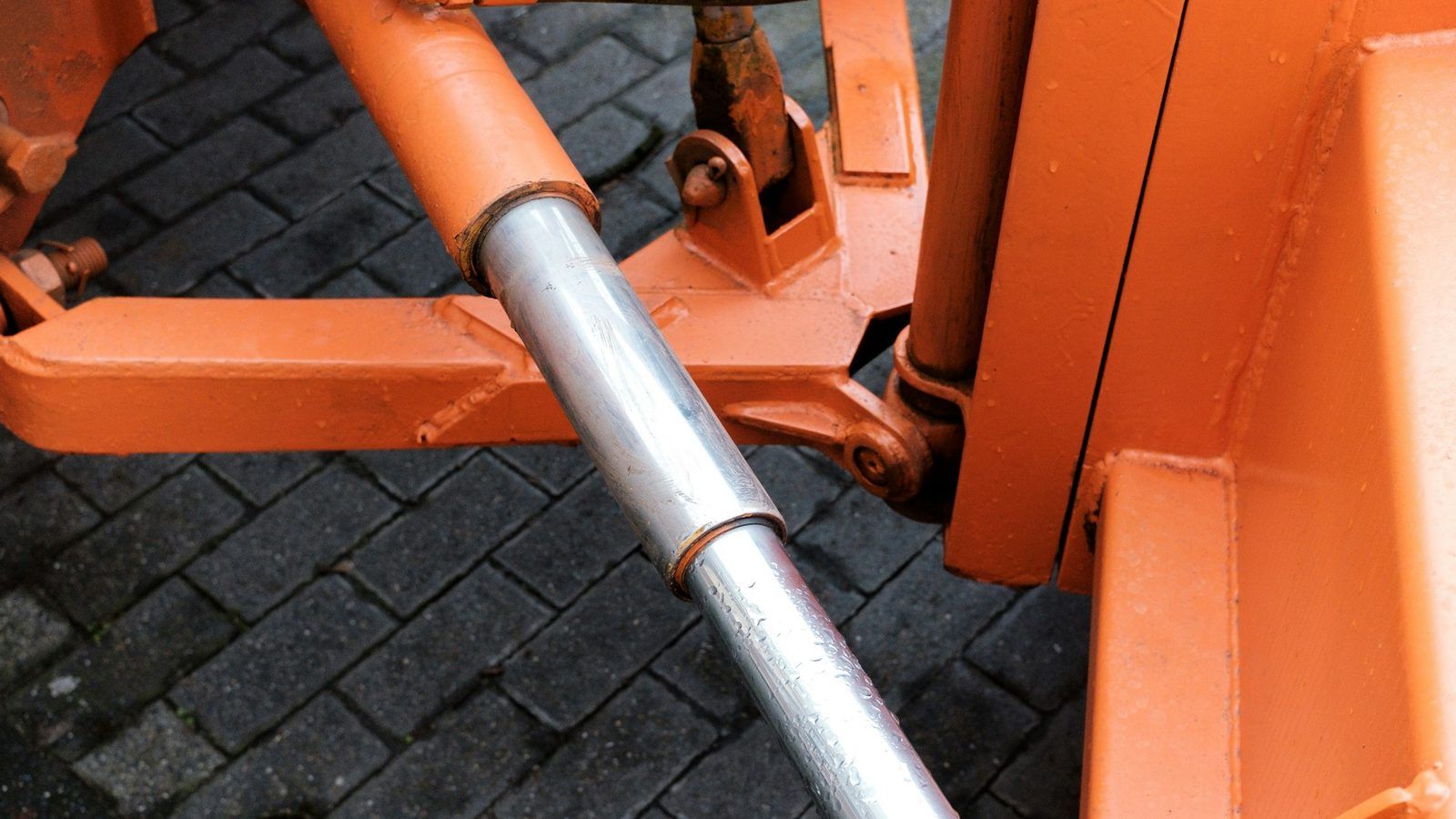
| Main cylinder and ram | The ram is pushed out by the oil and carries the load | Scored chrome or worn seal: creeps down, leaks |
| Release valve | Needle or ball valve that returns oil to the reservoir | Dirt on the seat: the jack sinks under load |
| Overload (safety) valve | Opens just above rated load and returns oil to the reservoir | Must never be adjusted by the user |
| Stroke limit / bypass | Stops the ram at full extension | Protects the ram from being pumped out |
| Screw extension (bottle jacks) | Threaded top of the ram that closes the gap to the load | Extended under load, it can damage the thread |
What happens on each pump stroke
- Up-stroke (suction). The plunger rises. The outlet check valve stays shut because of the pressure under the ram, the inlet check valve opens, and oil is drawn from the reservoir into the pump chamber.
- Down-stroke (pressure). The plunger is pushed down. The inlet valve closes, the outlet valve opens and the oil is forced under the ram, which rises by the pumped volume divided by its area.
- Holding. Between strokes and when you stop pumping, both check valves are shut and the release valve is closed. The oil under the ram is trapped, so the load stays up.
- Lowering. Turning the release valve counter-clockwise opens a path back to the reservoir. The weight on the ram pushes the oil back; a small opening lowers the load slowly, a large one quickly.
- Overload. If someone tries to lift more than the rating, the pressure reaches the setting of the overload valve, the valve opens and further strokes only circulate oil. European (EN 1494) and North American (ASME PASE) jack standards both deal with this protection.
How a bottle jack works
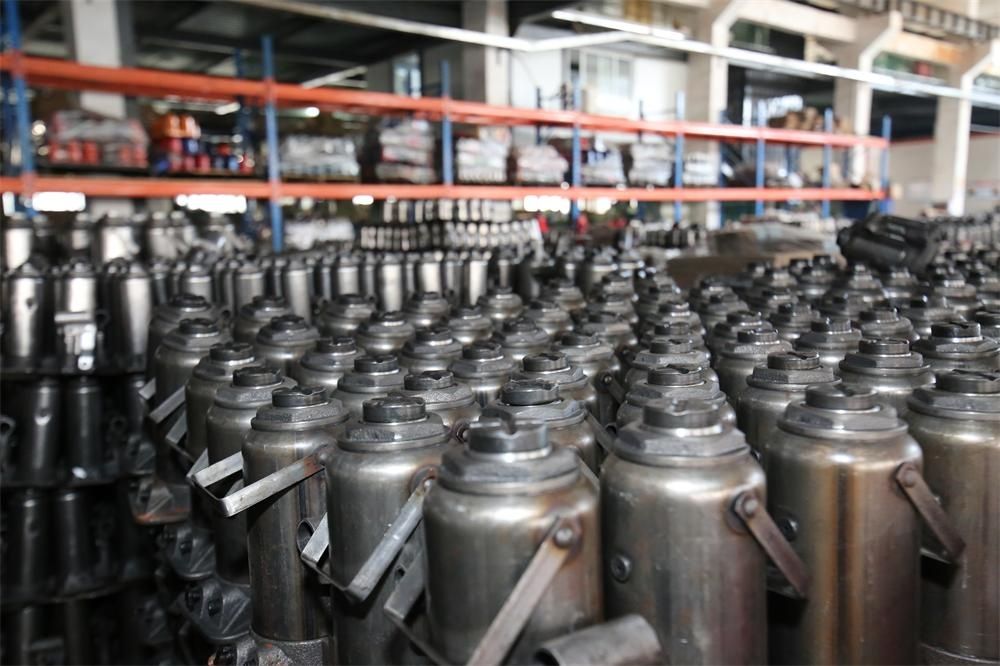
The bottle jack is the classic layout: the reservoir surrounds the main cylinder like the walls of a bottle, the pump sits beside it, and the ram rises straight up. Because the force goes straight into the ram, a small bottle jack is very strong for its size: our 20-ton T204 model weighs 10 kg (22 lb).
The limit is travel. The ram can only extend as far as the cylinder is long, so bottle jacks add:
- a screw extension on top of the ram (60 mm on our 20-ton T204) to reach the lift point before pumping;
- a two-stage, telescopic ram for more lift from a similar starting height: our 20-ton two-stage model lifts 285 mm (11.2 in) hydraulically, against 145 mm (5.7 in) for the single-stage version.
A standard bottle jack only works upright, because the pump draws its oil from the bottom of the reservoir.
How a floor jack works
A floor jack lays the same kind of hydraulic unit on its side in a low steel or aluminium chassis. The ram pushes on a short lever at the base of a long lift arm, so the saddle at the end of the arm travels much further than the ram itself. That is how our 3-ton garage jack goes from 135 mm (5.3 in) to 495 mm (19.5 in), a far wider range than a bottle jack of the same capacity.
Two consequences of that geometry:
- The saddle moves in an arc, so the jack rolls a little on its wheels as it lifts. That is by design: never chock or block a floor jack’s wheels while lifting.
- Dual-pump (“rapid lift”) jacks add a second, larger pump piston that moves more oil per stroke while the saddle rises to the vehicle. Once the saddle meets the load, the jack continues on the small piston. It reduces the number of strokes, not the capacity.
On most floor jacks the release valve is opened and closed by turning the handle, so the operator never has to reach under the vehicle.
Air-over-hydraulic jacks
Air hydraulic jacks keep the same hydraulic circuit and drive the pump with an air motor instead of, or as well as, a handle. Shop air runs a small, fast-cycling pump; our air bottle jacks work on 8–12 bar and keep a manual pump as back-up. They are used where heavy axles are lifted all day, in truck tyre shops, bus depots and fleets.
Why a jack is not a support stand
Every seal and valve seat in a jack holds back oil at high pressure. A speck of dirt on the release-valve seat, a little air or a worn ram seal lets the load creep down, and a side load or shock load can damage the jack. EN 1494, the European standard for mobile jacks, only allows work under a raised load when it is secured by other means, and every manual says the same: a jack lifts, jack stands hold. Our jack stand guide shows where to put them.
What this means when you buy jacks
The physics is the same in every jack. The difference between a jack that lasts and one that comes back under warranty is in the details:
- an overload valve set and sealed at the factory;
- a chrome-plated ram running in a honed cylinder, so the seals slide on a smooth surface;
- pressure-rated seals, with seal kits available for later service;
- a stated oil grade and a clean fill (see our hydraulic jack oil guide);
- a pressure test on every unit before it is packed.
Those points are on our own test sheet. See them applied to our hydraulic bottle jacks, floor jacks and air hydraulic jacks, or read how we test every jack.